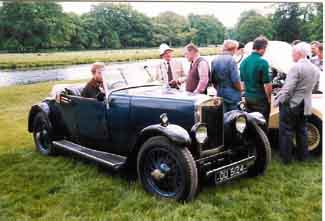

During 1927 Charles Van Eugen convinced the directors of Lea-Francis to allow him to design a completely new chassis assembly. Fitted with a Brooklands specification Meadows 4ED engine the chassis was designated the O-Type
| Engine: | Meadows 4ED (Brooklands), 1496cc, 11.9hp, 52bhp |
| Wheelbase | 9' 3" |
| Track | 4' 2" |
During 1927 Charles Van Eugen convinced the directors of Lea-Francis to allow him to design a completely new chassis assembly. Incorporating semi-elliptic springs front and rear the new chassis was longer and with a wider track than previous models. The trailing end of the springs was mounted in such a way that it slid in bronze trunnions, which were themselves able to rotate in their mounting. When well maintained this arrangement gave the new chassis a good ride quality and comparatively good road-holding for the period. The spur gear differential was gone in favour of a bevel gear version and torque reaction was now taken by the rear springs. The hand brake no longer operated on the transmission but instead through a second set of shoes in each of the rear brake drums. The radiator, while retaining the distinctive shape was taller and higher. A new plate clutch was designed which was eventually fitted to all cars on the new chassis when fitted with a Meadows 4ED engine.
This new chassis fitted with the 1.5 litre Meadows 4EC engine was designated the U Type. Fitted with a standard single port Meadows 4ED engine it was designated the P Type and with the twin-port Brooklands version of the Meadows 4ED engine the O Type. This chassis frame would also form the basis for that used on famous Hyper or S Type, the V Type and W Type. Made 3” longer the frame was also used as the basis for the T Type
In the O Type Lea-Francis created a truly sporting model on their new chassis frame. With two Solex carburettors, higher compression ratio and improved camshaft profile the 12/50 Brooklands specification Meadows 4ED meant the O Type was capable of a genuine 70 mph or more.
The majority of O Types were fitted with four seat tourer bodies and a few with two seater and dickey bodies.
Surprisingly few of these cars were built, a total of only 55 of which only two are believed to have survived ( both have been somewhat modified). It is possible the option of buying the cheaper P Type fitted with a twin-port Meadows 4ED engine fitted was the reason for so few O Types being built. Or, perhaps the sporting driver was more attracted to the still more powerful S Type.